


Firestick IPTV 2026 : Ultimate Guide to Setup, Apps, and Best Practices
Table of Contents
You can turn your Firestick iptv into a flexible live-TV and on-demand hub without changing your hardware or your habits. Firestick IPTV lets you stream channels and apps through internet-based services, giving you access to live TV, catch-up, and custom channel lists on the same device you already use for apps and streaming.
This guide walks you through what Firestick IPTV is, the top apps and services to consider in 2026, step-by-step installation and configuration tips, common troubleshooting fixes, and ways to squeeze better performance from your setup. Expect practical steps and clear choices so you can pick and run the best IPTV option for your needs.
What Is Firestick IPTV?
Firestick IPTV lets you stream live TV channels and on-demand content over the internet using your Amazon Fire TV Stick. It replaces traditional broadcast or cable signals with channel lists delivered via IP; you install an IPTV app or sideload a compatible player to access those streams.
Understanding IPTV Firestick
IPTV on Firestick uses apps that read playlist formats (like M3U) or connect to provider servers with credentials. You can use dedicated apps (IPTV Smarters, TiviMate via sideloading, Kodi add-ons) or a built-in player if the service supplies an app.
Streams arrive as HTTP/UDP packets instead of satellite or antenna signals, so your network quality directly affects picture and buffering. Configure your Firestick to allow third-party installs if you plan to sideload, and enable a reliable DNS or VPN only if required by the provider for access or privacy.
Typical playback features include EPG (electronic program guide), multiple quality profiles (SD/HD/4K), catch-up, and VOD libraries. Check codec support and available storage on your Firestick model to avoid playback or app-install issues.
Key Benefits of Using Firestick IPTV
You gain access to hundreds or thousands of channels from multiple countries without extra set-top boxes. IPTV services often bundle live TV, movies, and series at a lower price than many cable plans, and you can switch providers by changing the playlist or login.
On Firestick, IPTV apps integrate with your remote and offer features like channel favorites, category filtering, and external player support for better buffering control. Portability matters: you can move your Firestick between TVs and keep the same subscription, making it useful for travel or multi-room setups.
Scalability is another advantage — many providers let you stream on multiple devices simultaneously, letting you watch on Firestick and other devices at the same time.
Legal Considerations
Not all Firestick IPTV services operate legally. Licensed providers deliver authorized channel streams; unlicensed services rebroadcast paid channels without rights, which can expose you and the service to legal risk. Verify a provider’s licensing, look for reputable billing and contact information, and avoid services that advertise unrealistically low prices for premium channels.
Using IPTV on Firestick can also breach terms of service for certain apps or for Amazon if you install unapproved software. If you use a VPN, ensure it complies with local laws; VPNs do not legalize access to copyrighted content. Keep receipts and written service terms to prove that a subscription is legitimate if questions arise.
Popular Apps for Firestick IPTV
You’ll find apps that load M3U/Xtream playlists, offer EPG and DVR, and run smoothly on Fire TV hardware. Focus on apps with active updates, clear setup steps, and support for external players and EPG formats.
Overview of IPTV Smarters Firestick
IPTV Smarters for Firestick provides a familiar, remote-friendly interface and supports Xtream Codes, M3U URLs, and local playlists. You sign in with provider credentials or load a playlist; the app then presents Live TV, VOD, and catch-up tabs you can navigate with the Fire remote.
Key features include EPG integration, multiple user profiles, and external player support (e.g., MX Player, VLC). It also supports parental controls and basic DVR/timeshift depending on your provider.
Security and privacy depend on the IPTV service you use; the app itself does not supply channels. Check for the latest APK from official sources or the Amazon Appstore to avoid modified builds.
Top-Rated Firestick IPTV Player Apps
The most-used players on Firestick combine playback stability, EPG support, and ease of setup. Consider these options:
- TiviMate: Clean program guide, favorites, and multi-playlist handling. Best for cord-cutters who want a TV-like guide.
- IPTV Smarters: Broad provider compatibility and profile management.
- XCIPTV / Hypnotix-style forks: Feature-rich UIs and integrated VOD sections.
- Perfect Player / VLC / MX Player: Useful as external players for hardware decoding and advanced subtitle handling.
When choosing, prioritize apps that support EPG (XMLTV or M3U with EPG), hardware acceleration on Firestick, and reliable buffering management. Read user changelogs for Fire OS compatibility and bug fixes before installing.
Compatibility and Requirements
Your Firestick model and Fire OS version affect app performance. Fire TV Stick 4K and newer have better HEVC/4K support and more RAM; older sticks may struggle with high-bitrate streams.
Minimum requirements to expect:
- Fire OS 6+ recommended for modern apps and library availability.
- 1.5–2 GB free RAM for smooth multitasking and guide rendering.
- A stable broadband connection: 5–10 Mbps per SD/HD stream, 25+ Mbps for multiple 4K streams.
Also verify codec support and whether the app can use external players for hardware acceleration. Enable “ADB Debugging” only if sideloading APKs and avoid untrusted builds to reduce security risk.
How to Install IPTV on Firestick
You will install an Firestick IPTV player app, grant permission for sideloading when needed, and load your IPTV playlist or account credentials. Follow clear steps to download the app, enable unknown sources, and input your M3U URL or login details.
Step-by-Step Installation Guide
Start by turning on your Firestick and connecting it to the internet via Settings > Network. Open the Amazon Appstore and search for an IPTV player like “TiviMate”, “IPTV Smarters Pro“, or “Kodi” if available.
If the app appears in the Appstore, select Install and wait for completion. For apps not listed, you will sideload an APK (see the Downloader subsection). After installation, launch the app and choose the method to add channels—usually M3U URL, Xtream Codes, or provider username/password. Enter the IPTV provider details exactly as given.
Test playback on a live channel to confirm streams work and adjust video settings (buffer, player engine) in the app. Keep your Fire OS updated to avoid compatibility issues with IPTV apps.
Using Downloader for IPTV Apps
Install the Downloader app from the Amazon Appstore to fetch APK files directly to your Firestick. Open Downloader, enter the APK URL provided by your IPTV app source, and tap Go to download.
Once the APK downloads, Downloader will display an Install prompt. Confirm Install, then Delete the APK installer after successful installation to free storage. Use the Downloader browser cautiously: only download APKs from trusted sources or the official developer site.
If your network blocks downloads, consider transferring the APK via USB or using an SFTP method from a PC to the Firestick (requires additional tools). Always check APK file integrity and recent user reviews to reduce security risk.
Enabling Apps from Unknown Sources
Open Settings > My Fire TV > Developer options to enable installation from unknown sources. On newer Fire OS versions, enable this per-app: find the Downloader app in Settings > Applications > Install unknown apps and toggle Allow.
Granting this permission lets Downloader or other sideloaders install APKs not in the Appstore. Keep this setting disabled for apps you do not use to minimize security exposure. After installation, you can disable the permission again.
Also enable ADB Debugging only if you plan to use ADB for advanced installs; otherwise leave it off. Monitor app permissions and remove unused IPTV apps to maintain device performance and security.
Configuring IPTV Services on Firestick IPTV
This section walks you through installing a reliable player, loading your playlist or provider credentials, and tuning playback settings for smooth viewing on Firestick devices. Follow precise steps for app installation, playlist entry, and streaming tweaks to minimize buffering and navigation friction.
Setting Up IPTV Smarters on Firestick
Install IPTV Smarters by sideloading its APK or using the Amazon Appstore if available in your region. Enable Apps from Unknown Sources: Settings > My Fire TV > Developer Options. Use Downloader or ES File Explorer to fetch the APK, then open it and complete the initial permissions prompts.
Sign in with the correct account type when the app launches: “Login with Xtream Codes API” or “Login with Playlist (M3U).” Grant storage and network permissions so channel lists and EPG load properly. Keep the app updated; check Settings > About > Check for Updates periodically to avoid compatibility issues with your Firestick firmware.
Adding IPTV Playlists and Credentials
If your provider gave an M3U URL, choose the Playlist (M3U) option and paste the exact URL. For Xtream Codes, enter server URL, username, and password in the designated fields. Double-check for trailing slashes, typos, or copied hidden characters—those commonly cause failed loads.
After adding credentials, allow the app to import channels and EPG data. Look for these confirmation indicators: populated channel list, working guide grid, and playable sample stream. If channels fail to appear, remove and re-add the source, or try a direct file upload via USB if your M3U is local.
Adjusting Streaming Preferences
Open Settings > Player Settings inside IPTV Smarters to set video decoder options. Choose Hardware Decoding for most Firestick 4K models to reduce CPU load; switch to Software Decoding if you see playback artifacts. Set the buffer size to medium or large (5–10 seconds) to balance latency and rebuffering.
Manage audio and subtitles per stream under Playback Settings to avoid mismatches. Use the app’s network test or enable “Reduce Bandwidth” for limited connections. Finally, clear cache periodically: Settings > Clear Cache, and restart the app after major changes to ensure settings apply.
Best IPTV Services for Firestick in 2026
You can optimize channel selection, picture quality, and device compatibility by choosing providers that offer dedicated Firestick apps, UK channel packs, and reliable streams. Prioritize providers with transparent pricing, active support, and low-latency servers near your region.
Top Picks for UK Users
Look for providers that include UK-specific channel bundles: BBC, ITV, Channel 4/5, Sky Sports highlights, and UK catch-up options. Services like those with dedicated Firestick apps and UK regional servers reduce buffering and preserve HD/4K quality during peak hours.
Check whether the provider supplies EPG (program guide) with accurate UK time zones and support for subtitles or multiple audio tracks. These features make live sports and local news easier to navigate on a remote-driven Firestick.
Verify legal status and read recent user reports about uptime and channel availability. Choose a service offering UK-focused channel lists, a trial period or money-back window, and clear device-connection limits.
Subscription Comparison
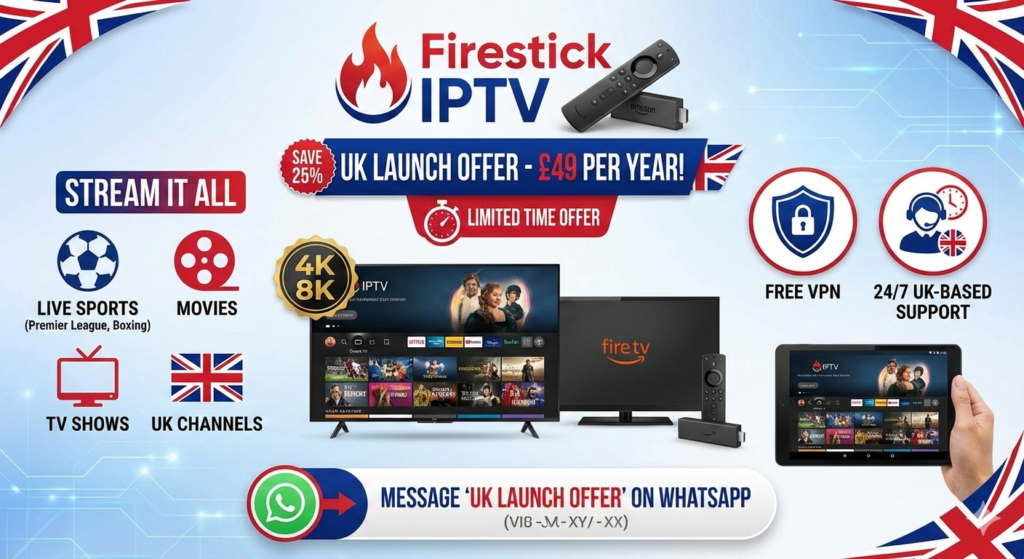
Compare key variables: monthly price, concurrent streams, 4K availability, and add-on packages (sports, movies, international). For example, plans typically range from budget (1–2 streams, SD) to premium (4+ streams, 4K, extra sports).
Look for included features: native Firestick app, zero-config m3u/JSON support, EPG, and customer support hours. These affect daily usability more than small price differences.
Also check payment options and refund policies. Providers that accept card/PayPal and offer short trials let you test performance on your exact Firestick model before committing.
Free vs Paid IPTV Providers
Free IPTV can provide occasional live channels or public streams, but you should expect inconsistent quality, frequent channel changes, and limited legal protections. Use free services only for testing or secondary content, not as your primary live-TV source.
Paid providers usually deliver stable streams, faster server response, and documented channel lists with UK coverage. They also include support and better security practices like HTTPS streams or tokenized access.
Balance cost against risk: a low-cost paid service with clear uptime and a refund policy often gives better viewing continuity than free alternatives that rely on unstable sources.
Troubleshooting Common IPTV Issues on Firestick
Quick checks usually fix most problems: verify your Wi‑Fi signal, confirm the Firestick IPTV app and Firestick firmware are up to date, and restart devices to clear temporary errors.
Buffering and Playback Problems
Buffering usually stems from network issues, app settings, or server-side congestion. Check your Firestick’s connection: move it closer to the router or use a wired Ethernet adapter (USB‑Ethernet) if possible. Run a speed test — aim for at least 10–25 Mbps for HD streams and 25+ Mbps for 4K.
In the IPTV app, lower stream quality or switch to an alternate CDN/stream source if available. Clear the app cache: Settings > Applications > Manage Installed Applications > [IPTV app] > Clear cache.
Also check for ISP throttling or peak-hour slowdowns; a VPN can help diagnose whether your ISP blocks or throttles IPTV traffic, but pick a high‑speed provider and enable split tunneling to avoid latency.
If buffering persists, try a different Wi‑Fi channel on your router, disable background downloads on other devices, and reboot the router and Firestick.
App Crashes and Error Fixes
Crashes and “app not responding” messages often indicate corrupt app data, insufficient storage, or compatibility problems. First, force stop the app and clear data: Settings > Applications > Manage Installed Applications > [IPTV app] > Force stop / Clear data.
Free up storage by uninstalling unused apps or moving apps to external storage where supported. If the app still fails, uninstall and reinstall the latest APK from a trusted source or reinstall from the Amazon Appstore when available.
Check Firestick OS version (Settings > My Fire TV > About) and update if a newer build exists. If errors include authentication or EPG failures, verify your IPTV service credentials and M3U/EPG links; contact the service provider if links are invalid.
Record any error codes shown and search the app’s support resources — that speeds troubleshooting.
Updating IPTV Apps
Keeping apps and system software current prevents compatibility and security problems. Update apps automatically: Settings > Applications > Appstore > Automatic Updates ON. Manually check updates in Apps & Channels > See All > [app] > Update if available.
For sideloaded Firestick IPTV apps, download the latest APK from the developer’s official site or a reputable repository. Before installing, enable Apps from Unknown Sources only for trusted sources and verify the file checksum when provided.
Also update Fire OS: Settings > My Fire TV > About > Check for Updates. After updates, reboot the Firestick, reopen the IPTV app, and reauthorize any login if required. If the newest version introduces bugs, keep the previous APK on hand or contact the app developer for a rollback or patch.

Tips for Enhancing IPTV Experience on Firestick
These practical tips focus on stabilizing your connection, improving picture and sound, and unlocking built-in features that save time and reduce buffering. Apply them directly to your Firestick setup for measurable improvements
.
Optimizing Network Settings
Check your Wi‑Fi band and router placement first. Use the 5 GHz band when possible for lower interference and higher throughput; move your router within 3–5 meters of the Firestick and avoid walls or appliances between them.
If Wi‑Fi still drops, connect a USB‑Ethernet adapter to the Firestick (model dependent) for a wired 100 Mbps+ link. That eliminates most buffering caused by wireless congestion.
Adjust Firestick settings: set DNS to a reliable resolver (e.g., 1.1.1.1 or 8.8.8.8) in your router or via a network app to reduce lookup delays. Limit other devices’ bandwidth during streaming—use your router’s QoS to prioritize the Firestick’s traffic by IP or MAC address.
Run a speed test: aim for steady 15–25 Mbps for 1080p streams and 35+ Mbps for 4K. If throughput falls below these targets, troubleshoot ISP or upgrade your plan.
Improving Video Quality
Choose the right player and codec support. Use IPTV players on Firestick that support hardware video decoding (H.264/H.265) to reduce CPU strain and improve playback. In the player settings, enable hardware acceleration and set buffer size to medium or high to balance latency and stability.
Select stream quality that matches your bandwidth. Force 720p or 1080p for unpredictable connections; reserve 4K only when your speed and TV can handle it.
Calibrate display settings on the Firestick iptv : set Display to match your TV’s native resolution and disable automatic scaling if it causes artifacting. In the IPTV app, enable audio passthrough or the correct Dolby option for your sound setup.
Clear app cache periodically and keep apps and Fire OS updated to ensure the latest decoding optimizations and bug fixes.
Utilizing Advanced Features
Use Electronic Program Guide (EPG) integrations to navigate channels quickly. Import an EPG XMLTV or use built‑in EPG support in your IPTV player so you can jump directly to live shows and scheduled recordings. That reduces time spent searching and avoids accidental stream changes.
Take advantage of favorites and channel groups to organize frequently watched channels. Create shortcuts on the Firestick home screen for your top apps or playlists to launch streams faster.
Leverage recording and catch‑up features where supported. Configure local storage (USB drive or NAS) and set recording schedules in apps that permit DVR-like functionality. Use subtitle options and multiple audio track selection in the player for multilingual broadcasts.
Finally, enable developer options sparingly—ADB logging and background process limits can help debug playback issues but revert settings after troubleshooting to maintain system stability.